

『Low Flow Coriolis Meter for Chemical Dosing』Related information(v cone flow meter|rotary gas meter|gallon meter|gear meter|metal tube rotameter|glass tube rotameter|nutating disk meter|transit time ultrasonic flow meter|wedge flow meter|pd meters|hydraulic flow meter|ultrasonic water flow meter|water flow meter|air flow meter|magnetic water flow meter|oxygen flow meter|gas flow meter|argon flow meter|air velocity meter|gasoline flow meter|fuel flow meter|ultrasonic water meter|digital water meter|nitrogen flow meter|solid flow meter|Oxygen tank flow meter|digital water flow meter|diesel fuel flow meter|steam flow meter|02 flow meter|compressed air flow meter|oil flow meter|liquid flow meter)

Low Flow Coriolis Meter for Chemical Dosing
Quick Answer
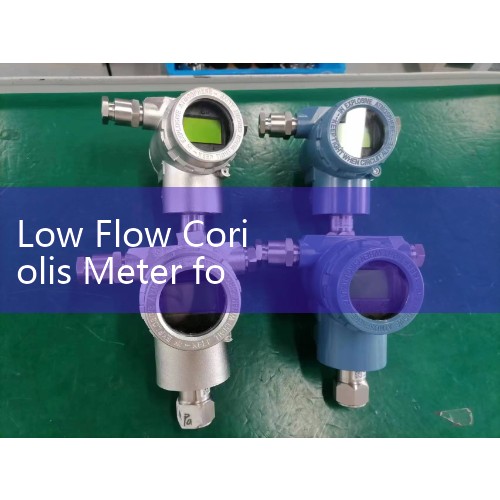
A low flow Coriolis meter gives you direct mass flow measurement of chemical additives without correction factors for viscosity, density, or temperature. For chemical dosing skids, Silver Automation Instruments supplies meters that deliver ±0.2% accuracy down to 0.1 kg/h, with no moving parts to service. If you inject coagulants, polymers, sodium hypochlorite, or acids, specify a DN3 to DN15 Coriolis with 4-20 mA HART and a built-in PT100 temperature sensor.
Why Chemical Dosing Demands a True Mass Flow Meter
Chemical injection systems handle fluids that change behavior with every batch. Coagulant concentration varies from one truckload to the next. Flocculant solution viscosity shifts as the polymer ages and water temperature swings. A volumetric flow meter will drift under these conditions and deliver the wrong dose. A Coriolis mass flow meter measures the actual mass of the chemical passing through the tube. Volume, density, and temperature all fluctuate but the mass reading stays stable. For water treatment plants in Thailand or plastic additive lines in Mexico, this repeatability means the dosing pump gets a trusted setpoint every scan cycle.
Here is the thing. Most engineers skip the maintenance cost of volumetric meters until they see a biofilm coat the oval gears or a turbine bearing seize on polymer residue. With a low flow Coriolis, you get a straight tube or a small bent tube with no internal obstructions. CIP and SIP cycles become possible. You avoid mechanical wear and the associated calibration drift. In plants where uptime matters more than saving a few hundred dollars on the meter, Coriolis quickly pays for itself.
What Makes a Low Flow Coriolis Meter Suitable for Injection Skids
Chemical dosing often runs at flow rates between 0.5 kg/h and 50 kg/h. A standard DN25 Coriolis cannot resolve a 0.2 kg/h trickle of scale inhibitor. That is why we size down to DN3, DN4, DN8, and DN10. The smaller tube inner diameter raises the fluid velocity and maintains the Coriolis deflection signal even at very low mass flow. In practice, our DN8 Coriolis meter handles flow from 0.05 kg/h to 100 kg/h, with a turndown ratio of 100:1. The wetted parts come in 316L stainless steel as standard and Hastelloy C-22 as an option for aggressive acids. Process connections are typically ¼ inch or ½ inch NPT, tri-clamp, or compression fitting to match your dosing panel tubing.
The meter body is compact enough to mount directly on a skid plate. Most installers bolt it right next to the pulsation dampener. There is no need for long straight pipe runs. A Coriolis meter does not care about swirl or velocity profile. You save panel space and avoid extra support brackets. In explosive atmospheres, we configure the housing for ATEX Zone 1 or Class I Div 1 so you can meter solvent-based additives at a paint factory in Brazil without a separate purge system.
Key Specifications Engineers Actually Care About
Mass flow accuracy is ±0.2% of rate for liquids across the full calibrated span. Density accuracy sits at ±0.002 g/cm³, which helps you detect air slugs or wrong chemical supply. The secondary output from the PT100 temperature sensor gives ±0.5°C, used by the DCS to compensate reagent activation energy. Process temperature range reaches -40°C to 125°C in the standard model. Maximum operating pressure varies with DN size, but a DN8 meter typically handles 100 bar when ordered with welded connections. Output options include 4-20 mA HART, active pulse, passive pulse, and RS485 Modbus RTU. Power supply is 24 V DC nominal, and the meter draws less than 3.5 W. Two configurable digital outputs can drive a preset dosing batch cycle or trigger an alarm when the tube drive amplifier detects a void fraction above 5%.
Real World Performance: A Chemical Dosing Case in Vietnam
Last year a polymer dosing company in Ho Chi Minh City contacted us. They had been using a small electromagnetic flow meter to measure cationic polymer injection into a sludge dewatering belt press. The polymer viscosity climbed above 800 cP in the morning when the dilution water was cold. The magmeter reading dropped by 12% even though the actual mass flow had not changed. The operator compensated by eye and often overdosed, wasting polymer and creating clumps on the belt. We supplied a DN10 Coriolis mass
We see similar results on antiscalant dosing lines in Saudi Arabian desalination plants, on paint additive injection in Thailand can coating factories, and on hydrogen peroxide metering in Australian dairy sterilizers. The common thread is a need for a flow meter that ignores viscosity shifts and gives a clean 4-20 mA signal the PLC can trust.
How to Select and Specify Your Coriolis Meter
Most suppliers will ask you for a dozen data points before they can recommend a meter. We keep it simple. Send us your chemical type, the minimum and maximum flow rate in kg/h, the pipe connection size (DN or inches), and the operating pressure and temperature. Our application team will cross-check wetted material compatibility against our chemical resistance database and propose one or two Coriolis models with a price quote. You will receive a dimensional drawing, wiring diagram, and calibration certificate sample in the same email. No generic brochures and no delayed follow-ups.
For bulk orders, we can tag every meter with your project equipment code, preset the HART address, and run a five-point calibration traceable to IEC 17025. Delivery from our stock takes 3 to 5 working days for standard DN8 and DN10 meters. Custom Hastelloy meters with high-pressure approval require 15 working days. Freight to Singapore, Jakarta, Dubai, or Santiago is arranged by our logistics partner and we provide all paperwork for import clearance.
FAQ: Low Flow Coriolis Meters for Chemical Dosing
What is the minimum measurable flow for a Coriolis meter?
A DN3 Coriolis can resolve as low as 0.02 kg/h with water at room temperature. For most chemical dosing applications, we recommend a DN4 or DN8 meter where the typical minimum mass flow is around 0.1 kg/h. The meter still reads below this threshold but accuracy may drop to ±0.5% of rate. We can program a low-flow cutoff value to force the output to zero when injection stops.
Can low flow Coriolis meters handle viscous chemicals like polymers?
Yes. Viscosity up to 10,000 cP or higher does not affect the mass flow measurement principle. The tube drive control loop automatically adapts to dampen the oscillation at high viscosity. What does change is the pressure drop across the meter. For a 5000 cP fluid, you may need to size up to a DN10 or DN15 to keep the pressure loss below 1 bar, so always let us know your viscosity when you request a quote.
Do I need straight pipe runs upstream and downstream of the Coriolis meter?
No. Coriolis meters are immune to velocity profile distortion. You can mount the meter directly after a 90-degree elbow, a dosing pump check valve, or a pulsation dampener. The only practical rule is to avoid mechanical stress on the process connections. Support the meter body using the optional mounting bracket and leave enough clearance to remove the transmitter cover for wiring.
Are these meters certified for hazardous areas?
We supply low flow Coriolis meters with ATEX Zone 1, IECEx, and NEC Class I Division 1 certifications. The intrinsically safe design uses an isolated 24 V DC supply and keeps the tube drive energy below ignition limits. You can specify a compact transmitter housing or a remote-mounted transmitter up to 50 meters away. All hazardous area models come with the relevant certificate and a coil tag number matching your ex register.
What is the typical price for a small Coriolis meter?
A standard DN8 or DN10 low flow Coriolis meter from Silver Automation Instruments ranges from USD 2800 to USD 4500 depending on wetted material, process connection, and approval requirements. A basic model with 316L, NPT threads, 4-20 mA HART, and no hazardous certification sits at the lower end. A Hastelloy version with tri-clamp fittings, ATEX Zone 1, and Modbus RS485 reaches the upper boundary. Send us your process parameters and we will return a line-item quotation with no hidden charges.
 Hot Product
 Related AD