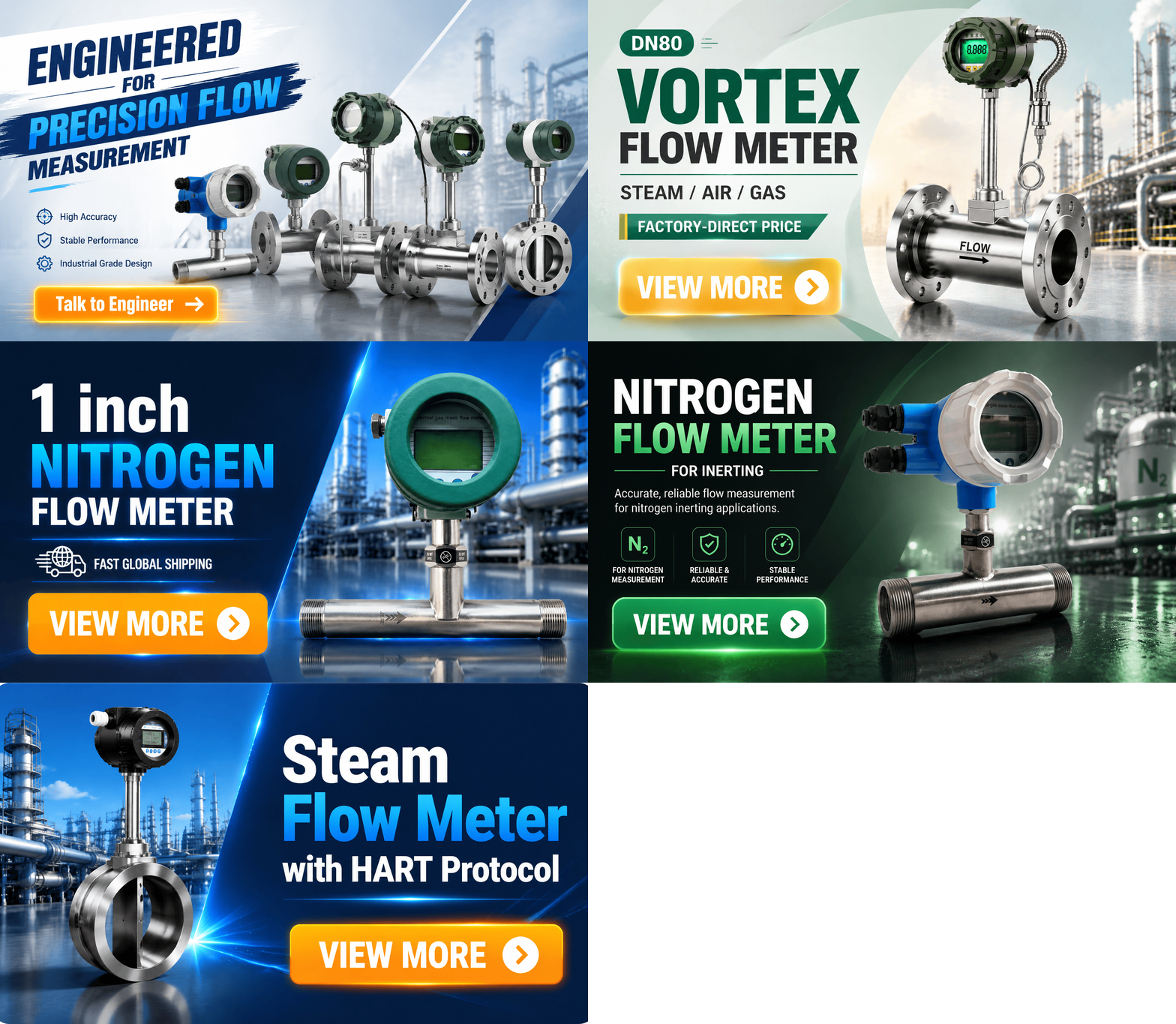


『Vortex flowmeter orifice flowmeter』Related information(v cone flow meter|rotary gas meter|gallon meter|gear meter|metal tube rotameter|glass tube rotameter|nutating disk meter|transit time ultrasonic flow meter|wedge flow meter|pd meters|hydraulic flow meter|ultrasonic water flow meter|water flow meter|air flow meter|magnetic water flow meter|oxygen flow meter|gas flow meter|argon flow meter|air velocity meter|gasoline flow meter|fuel flow meter|ultrasonic water meter|digital water meter|nitrogen flow meter|solid flow meter|Oxygen tank flow meter|digital water flow meter|diesel fuel flow meter|steam flow meter|02 flow meter|compressed air flow meter|oil flow meter|liquid flow meter)

What are the differences between vortex flowmeter and orifice flowmeter when measuring steam? Senior staff from Qingtian Instrument are here for you The main differences between vortex flowmeter and orifice flowmeter in measuring steam are reflected in seven aspects: accuracy, accuracy variation, universality, range ratio, pressure loss, maintenance cost, and service life. Specifically, accuracy: The orifice flowmeter strictly calculates the flow rate according to the national standard calculation formula. In demanding scenarios such as heating stations, it can provide more reliable measurement results and is suitable for steam measurement occasions with extremely high accuracy requirements. The vortex flowmeter uses a simplified formula to calculate flow rate, with slightly lower accuracy compared to orifice flowmeters, but it can still meet the requirements in general industrial scenarios. Accuracy variation accompanied by flushing and leakage: The orifice flowmeter has a smaller inner diameter, and the obtuse angle of the inner wall may change after long-term use, or the wall thickness may increase due to the accumulation of dust and pollutants, directly affecting the accuracy of the calculation formula and leading to a decrease in accuracy. The accuracy and linearity of the vortex flowmeter may drift after long-term use, but its performance can be restored through recalibration, making maintenance more flexible. Universality: Orifice flow meters require parameters such as pipe diameter, wall thickness, material, Reynolds coefficient, etc., which have high professional requirements and are usually only applied in specific scenarios such as heating stations. The calculation of vortex flowmeter is simplified, with l_600x400.jpg)
2. What flow meters are commonly used on steam pipelines?
The commonly used flow meters on steam pipelines mainly include the following types, which need to be selected based on actual working conditions, measurement accuracy, range, pressure loss, and installation and maintenance costs.
1. Working principle of vortex flowmeter: Based on the Karman vortex street principle, the steam flow rate is calculated by measuring the alternating vortex frequency generated by the impact of steam fluid on the triangular cylinder vortex generator.
. Th Hot Product
 Related AD